
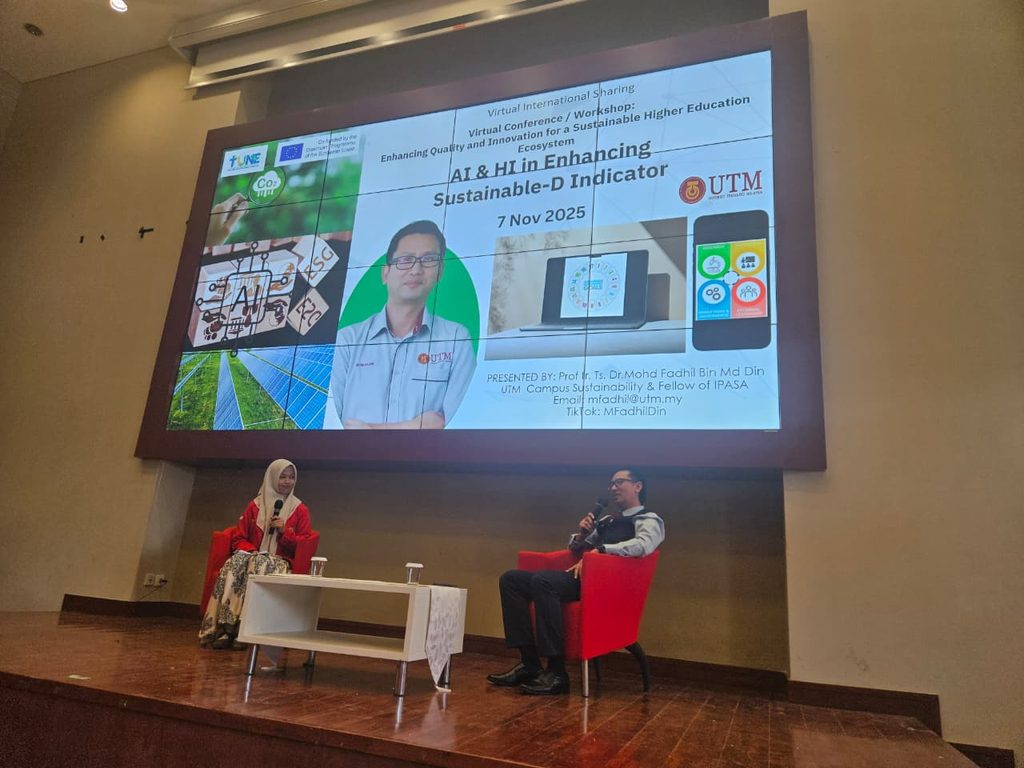
GOWA – The Department of Environmental Engineering, Faculty of Engineering, Hasanuddin University (FT Unhas), successfully held an international guest lecture (Virtual International Sharing / Virtual Conference & Workshop) on Wednesday (09/02/2026). The event, held at Lecture Theater 2, Center of Scientific Activities (CSA), FT Unhas Gowa Campus, was attended by approximately 140 participants, consisting of lecturers and students.
The event was officially opened by the Vice Dean for Research, Innovation, Partnerships, and Alumni Affairs of FT Unhas, Prof. Ir. Muhammad Bachtiar Nappu, S.T., M.T., M.Phil., Ph.D. The session featured an international speaker from Universiti Teknologi Malaysia (UTM), Prof. Ir. Ts. Dr. Mohd Fadhil Bin Md Din, an expert from UTM Campus Sustainability and a Fellow at IPASA (Institute of Environmental and Water Resource Management). Moderated by Marsha Anandhita, the discussion carried the theme “AI & HI in Enhancing Sustainable-D Indicator“.
Aligning Artificial Intelligence and Human Intelligence
In his presentation, Prof. Fadhil examined the rapid development of Artificial Intelligence (AI), which is increasingly entering various sectors and has the potential to become a competitor to humans in the workplace. Nevertheless, he emphasized that AI has fundamental limitations because it is not fully equipped with Human Intelligence (HI), such as Intellectual Quotient (IQ), Emotional Quotient (EQ), and Spiritual Quotient (SQ).
“The main focus is not simply how AI will replace human work, but how AI and human intelligence can be aligned to complement each other in supporting sustainable development indicators,” said Prof. Fadhil to the participants.
Fostering Environmental Awareness and Opening Opportunities to Contribute
Beyond discussing technology integration, Prof. Fadhil also encouraged Environmental Engineering students to view environmental issues from a broader perspective. He pointed out that climate change and environmental disasters, such as floods, are already very close to everyday life, yet are often addressed only after their harmful impacts have occurred. According to him, environmental awareness must begin with concrete actions, however small, in daily activities, without waiting for a crisis to occur.
He further inspired the students by stressing that the contributions of Environmental Engineering graduates are not limited to working in conventional industries.
“The opportunities for Environmental Engineering students to contribute are very broad. You can build your own environmental consulting firm, become collectors and managers of environmental data, or mobilize community participation through a citizen science approach,” he added.
Hopes for Sustainable Academic Collaboration
Through this guest lecture, the Department of Environmental Engineering at Unhas hopes to broaden students’ global perspectives, encourage more proactive environmental awareness, and strengthen international academic collaboration toward a sustainable higher education ecosystem.